The Agentic Browser Wars: Why ChatGPT’s Browser Died in Under a Year While Others Are Just Getting…
The Agentic Browser Wars: Why ChatGPT’s Browser Died in Under a Year While Others Are Just Getting Started

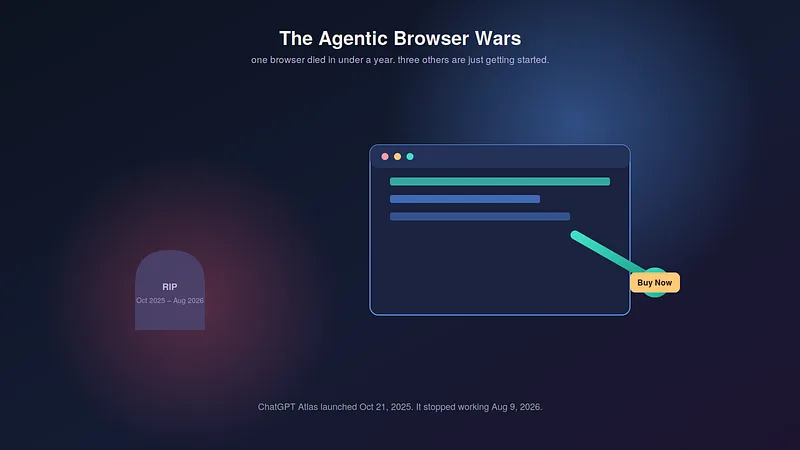
On October 21, 2025, OpenAI launched a dedicated web browser called ChatGPT Atlas, built around a bold idea: what if the browser itself could think for you? Less than ten months later, on August 9, 2026, it quietly stopped working. OpenAI folded its agent features back into the core ChatGPT app and a Chrome extension instead, and outside the AI press, almost nobody noticed it was gone.
That’s a strange outcome for a product category everyone agrees is the future. Because while Atlas was dying, its closest rivals — Perplexity’s Comet and Anthropic’s Claude for Chrome — were doing the opposite: growing fast enough to reshape what a browser is even supposed to do.
From “Search and Read” to “Ask and Receive”
For fifteen years, the browser’s job barely changed: render a page, let a human read it, let a human click things. What’s shifting in 2026 is the addition of a new layer sitting on top of that — one where an AI agent reads the page, decides what needs to happen, and clicks, fills, and submits on your behalf.
That’s the core distinction between a traditional browser and what the industry now calls an agentic browser. A traditional browser is a window onto the web. An agentic browser is an execution layer on top of it — capable of planning a multi-step task and carrying it out across several sites without a person clicking through each one.
A Crowded, Fast-Moving Field

By late 2025, nearly every major AI company had entered this race, each with a different bet on where the “agent” part of an agentic browser should live:
OpenAI’s Atlas bet on a standalone browser, and lost that bet — its own product page confirmed the shutdown after less than a year on the market.
Perplexity’s Comet took the opposite path: keep the base browser free, charge only for the deepest autonomous features. It launched on Windows and macOS in July 2025, went free that October, reached Android in August 2026, and was reportedly approaching 18 million monthly active users by mid-2026 — while raising $200 million at close to a $20 billion valuation to keep scaling.
Anthropic’s Claude for Chrome took a third approach entirely: don’t build a new browser, extend the one people already use. According to Chrome Web Store data, it grew from roughly 40,000 installs in December 2025 to more than 10 million by June 2026.
Google folded its own standalone effort, Project Mariner, into a feature called Chrome Auto Browse rather than keeping it separate — betting that Chrome’s enormous existing install base matters more than a flashy new app.
Apple took the narrowest approach of all: at WWDC 2026, it shipped an agentic feature limited to one task — Safari’s Passwords app can now visit sites and fix insecure passwords on its own, a small, contained job that fits Apple’s privacy-first instincts.
The pattern across nearly every winner so far is the same: bolt the agent onto something people already use, rather than asking them to adopt an entirely new browser. Atlas is the clearest case of the strategy that didn’t work; Comet, positioned as a genuinely new product with real differentiation for research and citation-heavy work, is the notable exception that’s holding its ground anyway.
What This Is Already Being Used For

This isn’t confined to demos anymore. Real, current use cases include:
Shopping and checkout — comparing products across sites, filling in shipping and payment details, and completing purchases with minimal back-and-forth.
Enterprise workflows — procurement, support, and compliance teams still rely on web portals and legacy tools with no modern API; an agent that can navigate the existing interface sidesteps building a custom integration for each one.
Research and synthesis — pulling information from multiple sources, summarizing it, and citing where each claim came from, which is where Comet in particular has built its niche.
Narrow, high-trust security tasks — Apple’s password-repair feature shows a more conservative model: let the agent act, but only where the blast radius of a mistake is small and contained.
The Bigger Claim: A New “Front Door” to the Web
The companies racing hardest in this space aren’t framing it as a browser feature update. Perplexity’s leadership has described Comet as securing the “front door” to what they call the agent economy — the idea being that whoever controls the interface people use to act on the web controls a meaningful chokepoint in how AI agents transact, shop, and work on people’s behalf going forward.
That’s a real strategic bet, not just marketing language. If AI agents increasingly complete tasks that used to require a person clicking through a website, the browser stops being a passive viewer and becomes the layer where value actually gets captured — which is exactly why five or six well-funded companies are fighting over it at once instead of one clear winner emerging quickly.
What’s Still Unsettled
For all the growth numbers, this category is still working through some serious open problems:
Security. Every capability that lets an agent act — filling a form, clicking a confirmation, entering payment details — is also a new surface for prompt injection, where hidden instructions on a malicious page trick the agent into doing something the user never asked for. Vendors have added confirmation steps, but even Google’s own documentation acknowledges those safeguards don’t eliminate the risk.
Trust and account access. Letting an AI agent act inside your logged-in accounts is a much bigger ask than letting it summarize a page, and adoption numbers so far suggest plenty of people are still deciding how comfortable they are with that.
Business model. Atlas’s failure suggests that a standalone browser alone isn’t a strong enough reason to switch — the agent has to be good enough, or embedded deeply enough into a tool people already rely on, to justify the change.
Fragmentation. With Comet, Claude for Chrome, Gemini’s Auto Browse, and Edge all pursuing slightly different visions of “agentic,” there’s no shared standard yet for how safely or consistently these agents should behave across the wider web.
Atlas’s rise and fall in under a year is a useful reminder that “agentic” being the obvious future doesn’t mean every specific bet on it survives contact with actual users. The browser is genuinely being rebuilt around AI agents right now — just not in the shape, or by the company, most people expected a year ago.
…………………………………………………………………………………………………
Sources: Tech Insider, “Perplexity Comet vs ChatGPT Atlas vs Gemini Agent,” September 2026; SearchViu, “Atlas, Comet, Claude for Chrome: The AI Browser Landscape in 2026,” August 2026; No Hacks, “The Agentic Browser Landscape in 2026,” July 2026; Yoopya News, “AI Browser War 2026,” July 2026. This article reflects publicly available information as of September 2026.
The Agentic Browser Wars: Why ChatGPT’s Browser Died in Under a Year While Others Are Just Getting… was originally published in Towards AI on Medium, where people are continuing the conversation by highlighting and responding to this story.
Explore my technical writing services and research samples or learn more about Soumi Ganguly.