Why Data Scientists Are Quietly Switching to Synthetic Data in 2026
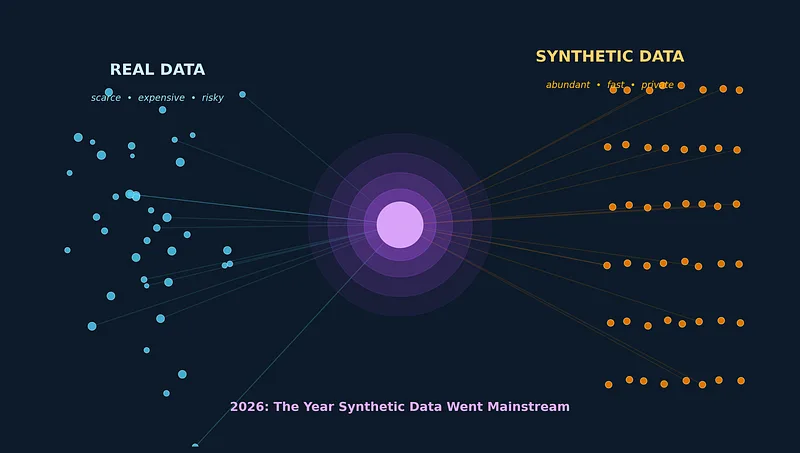
For most of the last decade, data scientists lived by one rule: real data beats fake data, always. In 2026, that rule is breaking down. Across fraud detection, healthcare, and customer analytics, teams are training models on data that was never generated by a real customer, patient, or transaction. It is synthetic, and it is becoming the default, not the workaround.
This is not a niche experiment. Gartner estimates that synthetic data will account for up to 20% of all data used in customer-facing AI models by the end of 2026. To understand why, it helps to look at the problem synthetic data actually solves.

The Real Data Problem
Real-world data has three chronic problems that no amount of cleaning fixes:
• It’s scarce where it matters most. Rare fraud patterns, uncommon medical conditions, and edge-case failures are exactly the events models need to learn, and exactly the events that barely show up in historical records.
• It’s expensive and slow to collect. Labelling medical scans or annotating financial transactions at scale requires expert time that most teams don’t have enough of.
• It’s a privacy liability. Using real patient or customer records for model training means carrying the risk of exposure, regulatory penalties, and breach of trust.
Synthetic data sidesteps all three. A generative model trained on the statistical patterns of real records can produce millions of artificial but realistic examples, including rare edge cases, without exposing a single real person’s information.
Where It’s Already Working
• Fraud detection: Since genuine fraud cases are rare relative to legitimate transactions, teams generate synthetic fraud patterns to train models that would otherwise never see enough real examples to learn from.
• Healthcare research: A 2025 review found that among synthetic biomedical datasets generated by language models, unstructured clinical text made up 78% of use cases, followed by tabular patient data at 13.6%, letting researchers study rare conditions without touching real patient files.
• Small language models: Rather than training a massive general-purpose model, companies now generate targeted synthetic datasets to train smaller, cheaper models that run locally and handle a narrow task, like classifying support tickets, just as well.
The Catch Nobody Advertises
Synthetic data is not a free upgrade. Researchers have documented a failure mode called model collapse: when models are repeatedly trained on data generated by earlier models, which were themselves trained on synthetic data, quality degrades with each generation. The outputs get narrower and drift further from real-world patterns, sometimes without any obvious warning sign in accuracy metrics.
There is also a harder, more basic question underneath the hype: synthetic data is generated by models trained on real data in the first place. If the seed data carries a bias, that bias does not disappear when it’s synthesized. It gets reproduced, and sometimes amplified, at scale.
Why This Matters for the Field
The bigger context here is a genuine resource constraint. Researchers project that frontier language models will exhaust the available supply of public, human-generated text by 2028. That deadline is pushing synthetic data from a convenient shortcut to a structural necessity for the entire field, not just a handful of specialized use cases.
For working data scientists, this changes what “knowing your data” means. It’s no longer enough to understand where your real data came from. Increasingly, you also need to understand the model that generated your synthetic data, what it was trained on, and what patterns it might be quietly distorting or leaving out.
A Practical Starting Point
• Use synthetic data to fill gaps, not to replace your entire dataset. It works best supplementing rare cases, not substituting the whole training set.
• Always validate against a real holdout set. A model that performs well only on synthetic test data is not a validated model.
• Track data lineage. Know which model generated your synthetic data and what it was trained on, so you can trace problems back to their source.
• Watch for collapse across generations. If you’re generating synthetic data from synthetic data, check quality at each generation, not just at the end.
Synthetic data is not replacing real data because it’s better. It’s gaining ground because real data is scarce, expensive, and legally risky in exactly the places models need it most. That trade-off is now central enough to data science that treating synthetic data as a side skill, rather than a core competency, is quickly becoming a real gap in a data scientist’s toolkit.
Soumi Ganguly, Marketing Director @Dhiyantra | Technical content writer & data analyst (4+ yrs) | Bylines: Hindustan Times, The Telegraph | AI, data & geopolitics.
Before you go
Please take a moment to like the post and follow the writer!
Did you know that over 400,000 developers share what they’re building, learning, and discovering across our platforms every month? Learn how you can contribute here.
Why Data Scientists Are Quietly Switching to Synthetic Data in 2026 was originally published in Artificial Intelligence in Plain English on Medium, where people are continuing the conversation by highlighting and responding to this story.
Explore my technical writing services and research samples or learn more about Soumi Ganguly.