Vibe Coding’s Shaky Foundations: What Cursor’s CEO Just Warned Every Developer About

The CEO of one of the fastest-growing AI coding startups on the planet just told a room full of developers: be careful with the thing that made you successful.
That’s the strange position Michael Truell, the 25-year-old cofounder and CEO of Cursor, found himself in at the Fortune Brainstorm AI conference late last year. Cursor is an AI-powered coding tool used by huge numbers of developers, and Truell’s job is to convince people that letting AI write more of their code is a good idea. Instead, he stood up and drew a sharp line between AI-assisted coding done well and the increasingly popular practice known as “vibe coding” — and warned that the second one is quietly setting projects up to fail.
What “Vibe Coding” Actually Means
The term itself is barely two years old, but it’s already become the shorthand for a specific way of working with AI: you describe what you want in plain English, the AI generates the code, and you never really look at what it produced. No reading the files. No understanding the architecture. Just describing outcomes and accepting whatever comes back.
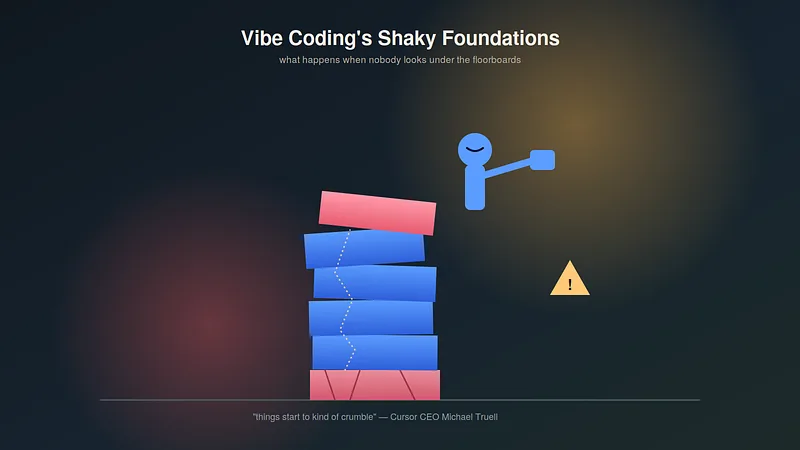
Truell described it plainly: it’s closing your eyes and asking the AI to build the whole thing for you. He compared it to commissioning a house without ever checking the foundation, the wiring, or what’s underneath the floorboards. You just want walls and a roof, fast.
For small, disposable projects, he pointed out, that’s genuinely fine. Mocking up a weekend game or a quick prototype doesn’t require anyone to understand the plumbing. The problems start when people try to scale that same close-your-eyes approach into something meant to last.
The Line That Went Viral
Here’s the part of his talk that got quoted everywhere: when you stack AI-generated changes on top of each other, floor after floor, without ever inspecting what’s holding it up, “things start to kind of crumble.”
It’s a simple image, but it landed because most developers who’ve tried AI coding tools have felt some version of it already — the moment a fast, magical first draft turns into a codebase nobody, human or AI, can fully explain anymore.
Why This Warning Carries Weight

What makes this notable isn’t just what was said — it’s who said it. Cursor’s entire business is built on developers trusting AI to write more of their code. Truell wasn’t arguing against AI-assisted coding. He was drawing a distinction between two very different things that both get called “AI coding” right now.
In his framing, Cursor is built for the disciplined version: AI embedded directly in the editor, drafting code the developer still reads, still understands, and can still debug — full function generation and autocomplete available, but always with a human able to step back in and look under the hood. The tool can do end-to-end tasks when you want it to, he said, but the option to inspect everything never goes away.
That distinction matters because of how fast the underlying claims about AI coding have been escalating. Microsoft and Google have both said that roughly a quarter of their companies’ code is now AI-generated. Anthropic’s CEO predicted that within months, the vast majority of all code could be AI-written. When percentages like that get thrown around, the natural question is: written how? Reviewed by whom? Understood by whom, if anything breaks?
The Debt Comes Due Later
This is really the same warning that shows up whenever a shortcut removes friction from something that used to require understanding. The cost doesn’t disappear — it just moves downstream, to the moment something breaks and someone has to figure out why.
With vibe-coded software, that moment tends to be worse than usual. A bug in code you wrote yourself is annoying. A bug in a system nobody on the team ever actually understood — because no one had to, until now — can mean starting the investigation from zero. Truell’s “crumble” isn’t a single dramatic collapse; it’s the slow accumulation of a codebase nobody can safely extend anymore.
What This Actually Means for How You Work

None of this is an argument for avoiding AI coding tools — Truell’s own company would fold if that were the takeaway. It’s an argument for a specific habit: stay able to explain what your code does, even when AI wrote most of it.
A few practices seem to separate developers getting real leverage from AI from developers quietly accumulating risk:
Read what gets generated, even when it’s tempting not to — especially for anything touching data, authentication, or money.
Reserve “eyes closed” mode for genuinely disposable work — prototypes, demos, throwaway scripts — and switch it off for anything meant to last.
Ask the AI to explain its own output, not just produce it. If you can’t restate why the code works, you don’t yet own it.
Review architecture, not just diffs. A change can look fine line-by-line and still be quietly building on a shaky floor below it.
Speed was always the pitch for AI coding tools, and for a huge range of tasks, that pitch is real. But speed only compounds well when it’s built on something solid. The floors go up faster than ever now — the only question Truell’s warning leaves every developer with is whether anyone checked what’s holding them up.
……………………………………………………………………………………………….
Sources: Fortune/Marco Quiroz-Gutierrez, “Cursor CEO warns vibe coding builds ‘shaky foundations’ and eventually ‘things start to crumble,’” Dec. 2025; MIT Technology Review, “AI coding is now everywhere. But not everyone is convinced,” Dec. 2025. This article reflects publicly reported statements and is current as of September 2026.
Vibe Coding’s Shaky Foundations: What Cursor’s CEO Just Warned Every Developer About was originally published in Towards Data Engineering on Medium, where people are continuing the conversation by highlighting and responding to this story.
Explore my technical writing services and research samples or learn more about Soumi Ganguly.